The year-end export pack your CA will ask for (and how to keep it ready)
Every March, exporters scramble for the same documents. Here is the list your CA will ask for, and a way to keep it ready all year.
When your exporter clients use Invoice Hub, you get the register, the realisation detail and the CA copies, through your own accountant-level login.
Every month a different file, a different layout, and a different version of the truth.
What actually arrived, when, and what the bank kept is rarely written down anywhere.
LUTs, FIRAs, rates and invoices arrive in pieces in March.
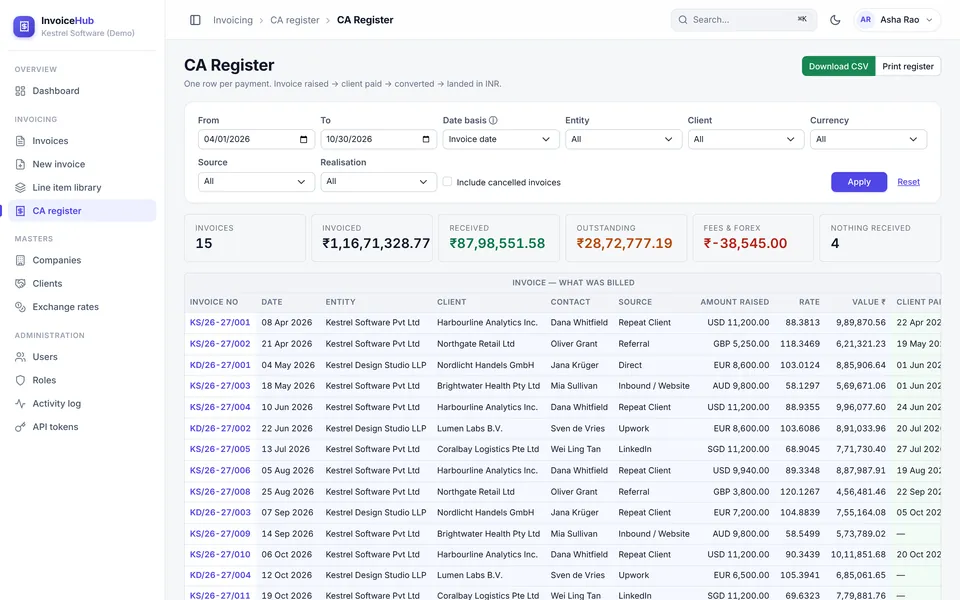
Every invoice with the figures you ask for: currency, rate, INR value, status, realisation. CSV or print.
A separate copy of each invoice with bank charges and realisation detail, never shown on the client copy.
See invoices, payments and the register. Not user management or bank settings.
Each rate records whether it came from CBIC, RBI or the bank.
Each company’s LUT per financial year, with its ARN and validity.
Sign-ins and changes in the activity log, visible to the organisation’s admins.
Users are included in each plan’s seat limit; an accountant login counts as one user.
Yes. The CA register exports to CSV, and the read-only API gives programmatic access.
Only if they give you a role that allows it. The standard Accountant role is built for review.
Yes. Tell us about your practice on the contact page.
Every March, exporters scramble for the same documents. Here is the list your CA will ask for, and a way to keep it ready all year.
Exports have their own table in GSTR-1, and getting it right decides how smoothly your refund goes. A practical walkthrough.
Shipping the goods is half the job. Here is how realisation works, which proofs you need, and why bank charges deserve a line of their own.
Tell us about your business and we will set up a walkthrough with your own companies, buyers and currencies.