The year-end export pack your CA will ask for (and how to keep it ready)
Every March, exporters scramble for the same documents. Here is the list your CA will ask for, and a way to keep it ready all year.
Each company keeps its own GSTIN, bank accounts, LUTs, branding and invoice series, while your team works in one organisation with the access each person needs.
Copying the last invoice from the wrong company is easy, and painful to unwind.
Separate tools per company mean separate passwords and no single view.
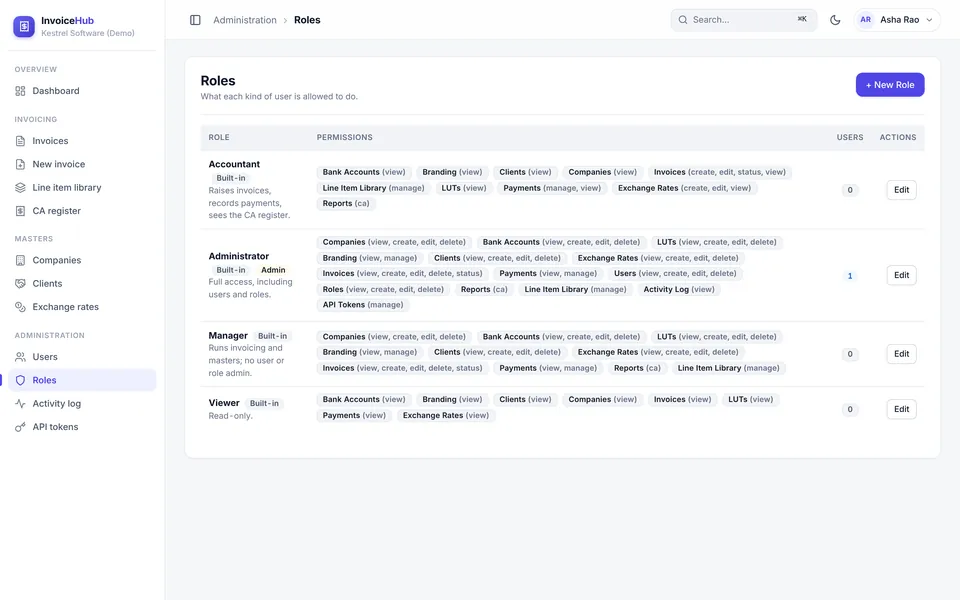
Without roles, the intern can see the bank settings.
Each with its own GSTIN, addresses, defaults, bank accounts, LUTs and branding.
Four standard roles, or your own, enforced on the server for every action.
Clients are shared across your companies, so buyer details are entered once.
What has been invoiced and what is outstanding, across the group.
Sign-ins and changes, so you always know who did what.
Read-only API keys for your ERP or BI tool, scoped to what the owner may see.
Up to 5 on Growth; unlimited on Enterprise.
Roles control actions across the organisation. For strict separation per entity, talk to us about your setup.
Assisted data migration is part of the Enterprise plan.
Yes, a read-only REST API for invoices, clients, companies and rates.
Every March, exporters scramble for the same documents. Here is the list your CA will ask for, and a way to keep it ready all year.
The GST rules set out exactly what a tax invoice must show, with extra requirements for exports. Use this checklist before the next invoice goes out.
A Letter of Undertaking lets you export without paying IGST upfront. Here is what it covers, who can file it, how to renew it each financial year, and the conditions that come with it.
Tell us about your business and we will set up a walkthrough with your own companies, buyers and currencies.